Infofest, or Festival of Informational Technology Achievements, is a central ICT event of international character in the region. In addition to the discussion panels and presentations, the festival’s program includes thematic conferences, lectures, exhibitions, consultations, and seminars.

During the festival, representatives of Bild Studio participated in the panel “ICT Sector in Montenegro” organized by the Association for Information and Communication Technologies of the Chamber of Commerce of Montenegro. During the presentation block of the program, attended by Montenegrin IT companies, Boško Kartal, a business development associate, and I presented Bild Studio at its best. We had the opportunity to present to the audience the current and previously successfully realized projects, the awards we received, and what makes Bild Studio so unique. And if you are to take us on our word, and you should, the strength of Bild Studio is in its people.
In addition to the presentation program, we attended the panel themed “Inspiring Women in ICT”, within the Erasmus+ project “Support to Young Women from Bosnia and Herzegovina and Montenegro in Entrepreneurship, Employment, and Leadership in IT”. This project aims to educate and develop the entrepreneurial spirit of young girls from Bosnia and Herzegovina and Montenegro, prompting them to bravely step out on and begin their career in the ICT sector through practice, informal education and transfer of knowledge and skills by the European partners.

During the panel, participants spoke about their experiences in the ICT sector and the reasons for choosing this career path. Among the participants were Aleksandra Bošković, executive director, and Amra Jukić back-end engineer, representatives of Bild Studio.
Events like Infofest are an opportunity to introduce to the general public the policy of our agency and to inspire colleagues from other companies, as well as the youth who is at the beginning of their careers. We will be pleased to support this and the similar events in the future.
On the World Tourism Day, the National Tourism Organization of Montenegro organized a lecture and workshop on the topic “Tourism and digital transformation”. Curious to see what this is about, Boško Kartal, a business development associate, and I went to a lecture and workshop that was hosted by Nicholas Hall, founder of Digital Tourism Think Tank (#DTTT), and one of the world’s leading experts in the tourismindustry.

During the lecture, we had the opportunity to hear how one of the tourism industry leaders sees the future of this industry, but also to pick up a few tips and complete the knowledge. It is indisputable that digital platforms are undermining the way tourism is taking place today. They affect the way destinations attract tourists, the way in which the product develops, collect data, access markets, and attract visitors.

So armed, and divided into groups, we participated in the workshop. After a brief presentation of the presentation, our group presented the advantages and authenticity of Montenegro as a tourist destination in front of the audience. We have come to use the natural beauty, the hospitality of the local population, its adventurous spirit and how to promote it.
We rejoice that thanks to the learned tricks of Nicholas Hall we will be able to improve the cooperation with our clients and partners.
Foto: Sergej Zabijako

We used the opportunity to also visit 2 of the 3 biggest cities in Sweden – Malmo and Stockholm, and the capital of Denmark – Copenhagen aswell, and to exchange knowledge and experiences with some of the leading startups and IT companies of Scandinavia. Served with the good weather conditions we were able to fully enjoy our trip until the last day of our visit.
I would describe Sweden as an optimistic version of the future. It is adorned by innovative, clean and minimalist design, with a focus on sustainability and functionality. High life standards, attention paid on the development of ecological sources of energy, care about the historical heritage, de degree of respect of the human rights are only some of the aspects enjoyed by the swedish society. Special care is dedicated to kids where every child has its place in kindergarten, while the books in schools are free.
The Swedes have the longest lifespan in Europe, the largest number of PCs per capita, 90 000 lakes… Their official Twitter profile is run by another citizen of that country every other week and they are also deserving for the first national park in Europe. In Sweden there is also garbage deficit so they are forced to import it from abroad so they could be able to continue recycling processes that produce huge amounts of electricity and fuel.

Malmo, which was the main base during our stay in Sweden, is the largest city in the southern region (Scania region). This region is extremely technologically advanced and is the place where many well-known brands are founded, such as Bluetooth, Tetra-Pak, Absolute Vodka and one of the brands they are extremely proud of – Zlatan Ibrahimovic. This city, as well as the whole of Sweden in essence, adorns multiculturalism, organisation, cleanliness, meticulousness, architecture and many bicycles – everyone rides a bike. From Malmo we easily moved to surrounding cities such as Lund and Helsingborg, where we had a really warm welcome from our hosts who at first broke the prejudices about the Swedes as the cold people, then Copenhagen and Stockholm.

We set out to Copenhagen over a staggering traffic phenomenon – the Oresund Bridge that transforms into an underwater tunnel and is one of the largest infrastructure projects in Europe. There we had the opportunity to visit the CBS (Copenhagen Business School) and to meet a large number of young and ambitious people in the presentations and workshops, share experiences and get a lot of information from first hand about the digital world of Denmark, the IT industry, trends and everything that can help us apply it to us.

The last stop of our visit was the capital of Sweden, Stockholm, one of the cities with the largest number of museums in Europe and the city that left the biggest impression on us. At the exit of the station we were spattered by the amazing blend of tradition and modern solutions. Over the bridges, since Stockholm was built on 14 islands, we headed toward the oldest part of the city, Gamla Stan, where we passed through the narrow streets and passages to the Nobel Museum. Then we continued to the royal palace which is in the vicinity of the Swedish institute, where we used the opportunity to share ideas with the coordinators of the program for reconstruction and development of this part of the Balkans.

After visiting the institute, our friend from Croatia, Antonio, who has been a resident of Stockholm for a long time, waited for us and led us to a real tour of a large number of attractions, such as Vasa Museum, Stadhuset – Stockholm City Hall, Ridarholm Church, etc. I have to mention that, although a programmer, he was very good in the role of a tourist guide.

The night was reserved for hangout with some of the leading people from the startup world of Stockholm where, despite the cold and the rain that started, we enjoyed talking with warm, cozy and sincere people.

Full of impressions, new knowledge and acquaintances, we returned to Montenegro eager to share our experiences and new ideas with our colleagues and friends, and put at least some of them into action.
Bild Studio is a digital creative agency with decades of experience in doing business, owing to a team of talented and experienced strategists, managers, designers, and developers. They pride themselves to be curious and passionate about strategy, design, and technology.
Through the current housing program for its employees, realized in cooperation with Erste Bank, Bild Studio showcases its affinity towards creativity and good intention. We sat down with Tarik Zaimović, one of the founders of the Bild Studio, and discuss how they support employees in solving this critical family issue.
During the conversation, we touched upon other topics too, like the values that the company nourishes, its development path, their experience with young people starting their professional careers, the prospects of the Montenegrin IT industry and many more.

Housing insurance for the employees is an unprecedented initiative in the private sector. How did you come up with the idea?
Housing security is one of the essential life challenges for employees, and I believe every responsible company should aim to help in resolving this challenge to the best of their abilities. The purpose of every job should be to ensure the safety and stability of individuals and their families. This idea originated from the company’s foundations, but only now we gained the financial opportunity for its realization.
The goal of this program is to help our employees when they are buying an apartment since we believe that young and creative people need our support. In the first phase, we provided 15 apartments for favorable conditions. In particular, the price per square meter is 270 euros lower than the market price. The apartments are in a good location, of quality construction and from a trusted investor. On average, employees who took part in this program are roughly 29-year-old; something of which I am proud of.
Besides favorable conditions when buying an apartment, the company pays the interest on housing loans for the employee, give the bill of exchange as an added security and relieve employees of fifteen mortgage loan installments while the building is under construction. In this way, employees avoid a burden of rental costs and housing loan rates at the same time. This program allows employees to save between 25,000 and 45,000 euros, depending on the size of the apartment. The obtained savings were due to the exemption from the interest rates, the favorable price we received and owing to payments in advance.
This is the best example of how style, shared goals, and arrangements among the collective can bring benefits to everyone. The purpose of this program is to provide our employees with housing. We hope that in the next year or two, at the latest three, we will begin with the second phase of the housing security program and that at last, this will become a business practice and part of the operating expenses of our company.
Why did Bild Studio choose Erste Bank as a partner in this program?
Before we opted for Erste Bank, we studied its competition in search of the perfect fit for our company. What distinguished Erste Bank from the others was its response time, professionalism, and communication.
Erste Bank is a textbook example of good project management and customer relationship. Should such a trend continue, I believe our cooperation will be a long-term one, and that we will expand it to other fields too.

What is Bild Studio’s vision? What are your values and the most important concerns?
For Bild Studio to become a synonym of a company that sets standards of good practice in business. And to be known as the company which invests in employees, company development, useful knowledge, and technology. It is essential that we are always prepared for change and consider as the responsible firm. The goal is not just to introduce examples of good practice and trends, but to anticipate and create them.
What puts us apart from others is the structure of our agency. The average age of our employees is 28 years. Besides being young, all of them possess the fundamental human virtues like work ethic, principle, loyalty, coexistence, willingness to work and to strive, but also a willingness to change. The great success of our agency and what we are proud of is the unchanged composition of people of crucial importance with us since its inception.
There are many young people in your team. Some are working for a long time, while others are at their beginning, improving their skills.
The new generations have become incredibly impatient, striving to become experienced high-level professionals overnight. In reality, this is unlikely to happen. Young people have problems with focus, work habits, and ethics, accepting suggestions, and criticism. I think the challenge of all companies will be to adapt to such trends.
It is imperative for young people to discover what they are best in because we are all destined to be good at something. One should love their work, as I believe passion is the best drive for success in any sphere of life. It is essential to have faith in yourself and have a dream, not to give up. Being guided by passion, in my opinion, is the only way to be fulfilled in your profession, and life.
How do you perceive the IT scene in Montenegro? Is the size of the market a limiting factor?
The IT scene in our country is at a low level measured against the world’s parameters. There are only a few domestics companies developing software products, of which a large number focuses on the local market instead of placing its focus abroad, which gives more significant opportunities. Technologies applied by many of the IT companies are not in line with trends, such as artificial intelligence, IoT, Augmented Reality, Blockchain, Data mining, hardware platform programming, smart home, cities, etc. There are almost no domestic firms that sell their products on several continents, as is the case with the IT companies from the region. The deficiency of high-quality personnel is something that every country in the world faces. This is not only a problem specific to the IT industry. However, Montenegro has the smallest number of software engineers per capita in the region. There is no organized cooperation between IT companies, although this is necessary and already an established practice in the region and the rest of the world.
There are several limiting factors, but the ICT industry in our country records constant growth in all parameters – profit, income, the number of professionals, average salary. Although demanding, I think this is one of the best industries to work in and we need to explore it further.
It is undeniable that Montenegro is a small market, but regarding ICT you are not dependent on the local market. Instead, your market is international. To enter the global market, you need knowledge, the experience, a copious amount of failures and time.
You are a member of a working group for creating educational programs.
Bearing in mind that there is a deficit of the experts in the information technology field, not only in our country but also in the region, one of the main goals was to create an educational program in line with the needs of the economy and the market, which is in line with the latest technologies and principles.
The educational program for the secondary vocational schools in Montenegro, in the IT field, will be one of the more innovative programs in the region. I am proud I had the privilege to contribute to the creation of educational programs for young people, and I must point out that this project has recently been one of my favorites.

Bild Studio has received many awards for social responsibility.
Bild Studio focuses on socially responsible business, both in the domain of human resources and the community. We are flattered because our work was recognized and awarded several times over the last couple of years.
Bild in three volumes
Setting the foundations
Everything started in high school, 12 or 13 years ago, when we set the foundations of the agency based on friendships, integrity, and trust. The essence of our business stems from this. Our slogan illustrates it the best, “bild.better.together.” I have learned these principles and lived by them during my high school years. Besides being true to these principles, I was fortunate to be surrounded by curious people, who taught me a lot about music, sports, games, profession, upbringing, and adventurous spirit. I owe special gratitude to my dear aunts, with whom I lived while attending high school. These women gave me unreserved support and love, and I am honored to call them my other mothers. With them, I learned the importance of giving, harmony, care, and love.
Student days
We worked from our student dorms, with an eagerness, hope and desire to succeed. We invested the first earnings in the necessary equipment. At the insistence of our business partner, we took advantage of the opportunities provided by the Government Project “Business incubator.” In four years, we had subsidized office space, equipment, and electricity. For us, at that moment, it was enormous support. A few of us worked from 14 to 16 hours a day, while often the whole collective spent months in continuous work, including weekends. Some of the first websites we made at that time were the site of the Faculty of Information Technologies, CANU, the companies of Gugi Komerc, the Parliament of Montenegro, the Police Directorate, Cafe del Montenegro. These clients placed us in the Montenegrin market. This period was pleasant, even though we worked a lot, and it was somewhat stressful and financially unstable since we could barely earn our salaries.
Appearing on the foreign market
Appearing on the foreign market marks our third phase, during which we risked the most. It was the first time we got a project beyond the borders of Montenegro. A plan for which we did not have the knowledge, experience, references, or the team that could deliver results. We also raised a loan for purchasing adequate equipment and moving to the new offices. In this process, we were lucky because we met a few people, our partners today, without whom this company would not be where it is now. After this period, the agency had almost linear progress according to many parameters, such as the number of employees, clients, income, profit, investments, and wages. Today’s business would not be imaginable without these foreign clients. Of the company’s total revenue, 70 percent stems from the 30 percent of the jobs we do for the international clients. So far we have realized more than a thousand projects for over 400 clients from almost all industries. We began with the financial sector, small and medium enterprises, government institutions, municipalities, media, faculties, heavy industry, international organizations and corporations, NGOs, and the hospitality sector, even the gaming industry in the fields of software, websites and mobile applications, marketing, design, video production, press, project management, consulting and training. The largest retail chains in Belgium use some of the software we are developing, 60% of Swedish municipalities, leading Swedish universities, young athletes in America, companies like Burger King, McDonald‘s, etc. Regardless of the results achieved, I still cannot say we are a successful company. I think we have only made good foundations. Our business goal is to become a 100 percent export agency operating just in strong economic markets. The strategic goal is to transform the current agency into a group which will own specialized firms and products.
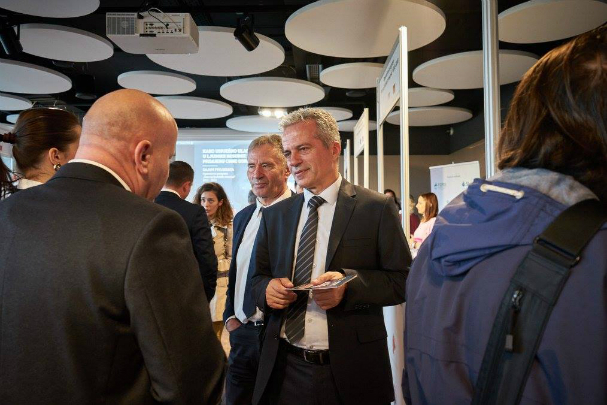
Final Conference for the Operational Programme “Human Resource Development” 2012-2013, was held on 24 October at the CenterVille Hotel & Experience, whereat the overall results of the projects were presented. After the conference, a Project Fair was opened on which 23 grant beneficiaries presented the results of the projects they been implementing in the previous period.

These two events are part of the project “Strengthening the Publicity and Visibility of the Operational Programme “Human Resource Development 2012-2013”, which we carry out in cooperation with the Directorate for Financing and Contracting of EU Assistance (CFCU) within the Ministry of Finance. This project aims to adequately inform the public about the activities and achievements of the Programme, which is part of IPA component IV, focused on the development of human resources.

The implementation of the Programme started in December 2014. 40 projects in the field of employment, education and science, social inclusion and technical assistance are in the final phase of implementation, and all activities will be finalized by December 31 of the current year. For the purpose of presenting the Programme’s overall results, we have created a video animation.
Although there are still several months of intense work until the official end of the implementation of the Operational Programme, when we will able to measure the final impact of this Programme on the well-being of Montenegrin citizens, we already have remarkable results, Minister of Labour and Social Welfare, Kemal Purišić pointed out.
Institutions composing the Operational Structure for the IPA IV Component and responsible for achieving these results are: the Ministry of Labour and Social Welfare, the Ministry of Education, the Ministry of Science and the Ministry of Finance of Montenegro. However, the key collaboration through individual projects is established with representatives of non-governmental organizations and associations, local self-government, private companies and employers, faculties and schools, said Darko Petrusic, General Director of the Directorate for Scientific Research Activities of the Ministry of Science.

Mubera Kurpejović, Assistant to the Minister of Education, emphasized the importance of training of 180 teachers, which is a long-term solution for producing adequate staff on the labor market.
Equal opportunities for all individuals is the most important goal of this Programme, emphasizes Hermanne Spitz, head of the European Commission Delegation for Cooperation in Montenegro, This is reflected in the main message of the Programme: “We invest in people our most valuable resource” and adds that the European Union will continue to financially support Montenegro on its way to the EU in the forthcoming period.

Project Fair was opened after the conference, whereat 23 grant beneficiaries presented the results of their projects supported through the Programme. Bild Studio presented the outstanding results achieved in two projects:
- “Transfer of knowledge between education and research institutions and the business sector”, a project implemented in cooperation with the Faculty of Information Systems and Technology of the University of Donja Gorica.
- “Montenegrin Medical Tourism Information System”, as partner of the Faculty of Information Technology of the University of Mediterranean.
The total amount allocated for this Operational Programme amounts to € 5,803,344.00, of which 4.932.839.00 € are from European Union (EU) funds , while national co-financing is 870.505,00 €.
For more information on the Operational Programme “Human Resources Development” 2012-2013, visit the official web site: www.ipa4.me.
Foto: EU info centar.
But what’s not surprising is that Bild Studio is again part of the Somo Borac jury, represented by Ksenija Ikovic, Head of Design.

Somo Borac is a regional digital marketing competition held within the Rovinj Weekend Media Festival. The fifth in the row, SoMo Borac comes with the most novelties so far. The most interesting thing is that after four years of free registration, organizers will start charging. The price per application is 99 euros, and as the organizers say, the payment will ensure even higher quality of applications and the competition itself, today and in the future. Also, this year applicants can submit their applications only through a video presentation.

One of the news is also a somewhat larger regional jury that, as before, will be composed of experts from the best agencies in the region. The honor to present our agency was given to Ksenija Ikovic, Head of Design, whose expectations from this year’s festival and tips for preparing presentations can be read on the link.

Also, the organizational team involved a behavioral psychologist, Boris Surija, in the evaluation process. Changes occurred in categories, as well. Hence, with new categories of SoMo Web and SoMo App, jury will award the best website or the best mobile application.
“I think the most important change is the evaluation system itself, given we sought for even better quality judging,” says Ružica Vrdoljak Ličina from the SoMo Borac organization.

You can submit your application by September 7, and the award will be held as part of the 10th Weekend Media Festival, 21 – 24 September, in the premises of the old tobacco factory in Rovinj. Last year’s finalists and winners, as well as all other Somo Borac news, can be viewed on the SoMo website.
Our programmers Uroš Gogić, Emil Balija and Anton Nikprelaj participated in the PHP konferenciju 2017, held on 27 – 28 May in Belgrade. The conference aims to bring together those who want to expand their knowledge and skills in PHP technology.

This year’s event was an ideal opportunity to learn from the great experts in the industry and learn out about the innovations in PHP, web technologies, architecture and code testing. Interactive presentations encouraged discussions on the development of IT industry in the domestic and international markets, and as expected, the greatest interest was shown for the creator of PHP language, Rasmusa Lardorfa.

PHP enthusiasts learnt about the websocket technology, challenges in building microservices, DDD concepts, building API based on Slim framework, found out more on the advantages and disadvantages of different database systems and so on.

Although the lectures were largely focused on the theory, attendees also discussed practical issues, problems and solutions to be included projects.Lecturers recommended different software tools and discussed the topic of recent trends in PHP programming.

The conference was attended by numerous regional and international professionals and we are very pleased to have been part of the event which has given us the opportunity to exchange experience with colleagues from other companies. Our expectations were accomplished, hence, we will attend PHP 2018 for sure, because it is of great importance to keep up with trends and needs in the industry, constantly educate and share knowledge with colleagues and experts from different companies and countries.
Each journey brings a new experience, and every year, families plan their travel destinations. This spring, our, not so small family, with its 15 members, headed to the two-day knowledge roller coaster – fifth Spark.me conference.

Day I
Predrag Lešić, CEO of the Domain.me company, founder of Digitalizuj.me, brilliantly announced the start of another successful conference, raising the question: How many sparks you need to hold the Spark.me? The answer: Only one. A special, magical spark, because everything is in that one spark that starts the flame.
The honor to open this year’s Spark was given to Max Mckeown, an English writer, consultant, and researcher specialized in innovation strategy and leadership, who used his extremely interesting illustrations to show the importance of timely strategic planning which will lead us, not from point A to an imaginary point B, but to the innovation, which is hidden in the future. He taught us that only ourselves can find it. He gave us a little hint: Just send yourself a message in a bottle, that will help you to shape your future and reach the paradise.

In a later talk with Max, our attention was drawn to a tattoo on his left forearm, which, how it turned out, was not really a tattoo, but a Max’s ideas recorded with marker. Namely, each time he prepares for the exhibition, he draws illustrative thesis, but depending on how he feels the audience, the lecture goes in a slightly different way every time. Well, it seems that even the greatest teachers sometimes, just like that, smuggle a little. ;)

Inspire and develop those who create tomorrow is a LEGO’s mission, as presented by Peter Kim, VP of Digital Consumer Engagement at the LEGO Group. Speaking of our witnessing that the world is slowly but surely moving from physical to digital, he pointed to the importance of a brand communicating. His advice is to always be those who can laugh, who spread the light to others and those who believe in the brand story, because only through honesty we can get closer to our clients.
Robert Fitzpatrick, tech entrepreneur,has drawn attention to importance of positioning ourselves as an honest brand and discussing all aspects with customers in today’s world where everybody lies. For a company that is at its growing stage, acting too big is fatal. Do not go in the growth and expansion if initially you are not well acquainted with your customers, because it can be disastrous for your business, advised Robert. He mentioned three key steps for building a successful business, first, you learn; second: you get confirmation, and only then you start to grow.

Shortly after Robert, Matt Desmier fronted the stage. He moderated the panel discussion on technology, health and welfare. The panelists were: Cate Murden (founder of PUSH Mind and Body), Fern Miller (Chief Strategy Officer, International, DigitasLBi), Mary Keane-Dawson (entrepreneurial leader and business mentor), who spoke about the fact that people are not really aware of dangerousness of treating ourselves computers. For causes dissatisfaction despite all the blessings we are surrounded with.
Jason Romeyko, Global Executive Creative Director at Serviceplan Group, advised all those who hesitate to start their own business, to go out and try, encouraging them not to be afraid, as fear must be converted into curiosity. As a grand finale on the first day, Kamran Elahian, philanthropist, entrepreneur without borders and a global venture capitalist, said: Social entrepreneurship has a positive impact on a society and it is the message you need to transmit to all.

Day II
Heather B. Armstrong, world famous blogger in the field of parenting, had a honour to open the Day II. She revealed: “You can be the best copywriter, expert in marketing or sales, but if you do not know the secret: The way you perceive people, they believe, nothing else is true.” Also, as much as it may seem contradictory to the modern capitalist system, Heather spoke about necessity to draw our attention to the empathy that really reaches out, not only to users, but to an each its cell.
Jon Burhart, award-winning keynote speaker and copywriter, with his ball concept, will certainly be remembered as one of the most interesting speakers at the conference. He proved that with a different approach you can get, and most importantly, keep the attention in real time.

A little bit extravagant Virginia Salas Castilo, CEO of consulting company Ginicanbreathe, has attracted attention with her appearance, but also with her lecture about the unpredictability of social networks, and possibilities of the Snapchat. After her, Sharad Sagar, a young entrepreneur from India who is on Forbes’s list of 30 successful people younger than 30 years appeared on stage.

Ancilla van de Leest, digital privacy and rights advisor, made us laugh with her question: Is there anybody that has never made a selfie? And then recalled to the original promise that the technology is only there to serve us. Yet, today we ask the question: Whether the smart home was really a stupid idea? Drawing attention to the importance of privacy protection in the digital world, she gave us 3 small tips: Be smart, be safe and be happy!
Rory Sutherland, Vice Chairman of Ogilvy & Mather UK, and co-founder of Ogilvy change- “the man, the myth, the legend,” as he was announced by Vladimir Vulić. Standing ovations, five-minute applause and the best possible finish of the fifth Spark.me conference. He introduced us with his concept of the brain perception, spoke about necessity of good marketing, and, yet, just won’t asking for help in this area. He particularly advised to think 10 times: “The longer the longitude, the better it is!”

Photo source: https://www.facebook.com/sparkdotme/
This year’s Spark.me confirmed the label of greatest marketing conference in South East Europe. We are already packed for the next year, eager for knowledge, new experience, creativity and inspiring speeches. Spark.me, just gives a date! ;)

Photo source: https://www.facebook.com/sparkdotme/
Bild Studio and Directorate for Finance and Contracting of the EU Assistance Funds (CFCU), within the Ministry of Finance, signed a contract with the aim to efficiently implement the Communication Action Plan under the Operational Programme for Human Resource Development 2012-2013, which will promote the activities and achievements of IPA Component IV.

The right to use the Component IV funds is reserved only for candidate countries, which was granted to Montenegro in December 2010. IPA Component IV – Human Resources Development is a program framework that offers support in the areas of employment, education, social inclusion, and integration, as well as support to strengthening the institutional capacity and efficiency of state administration and public services in accordance with EU policies and standards.
The works on the Operational Programme started in March 2010, and after extensive consideration at the local and national level it was adopted by the Government of Montenegro two years later. The main objective of the projects under the Programme is to promote sustainable human resource development, modernization and development of education and training systems in Montenegro in accordance with the EU policies and standards with a particular focus on youth employment.

Bild Studio applied for a tender that relates to the Strengthening the Publicity and Visibility of the Operational Programme “Human Resources Development” 2012-2013” in Montenegro, at the beginning of December 2016 and signed a contract with the Ministry of Finance on 26th May 2017. The purpose of this service contract is to inform the wider public and specific target groups in Montenegro about the EU, its policies and human resources development program and to promote the activities and achievements of IPA Component IV.
As part of the Technical Support Program, Bild Studio will carry out a number of activities in the domain of visual identity (design a logo, promotional material, provide technical support in publishing, etc), then develop an unique website, conduct numerous marketing and PR activities, from slogan and accompanying messages to the organization of a press conference and preparation of a promotional video that will sum up all the results within the Programme.
The total amount of funds allocated for the Operational Programme Human Resources Development 2012-2013 is € 6,568,240, of which 85% i.e. € 5,583,000 is financed by the European Union through IPA funds, and 15% i.e. € 985,240 as the co-financing is provided through the capital budget of Montenegro.
Every last Thursday in April is traditionally celebrated as the International Day of Girls in ICT. Aleksandra Bošković, General Manager of Bild Studio, held a lecture on that occasion at the elementary school “Pavle Rovinski” and brought closer the IT world to the 7th grade pupils.

Just until recently, the IT industry was considered as the male sphere; however, in the recent decade, more talk about the role of women who are contributing to the advancement of the IT sector. The International Day of Girls in ICT is marked with the aim of raising the awareness of girls about the importance of information-communication technologies and their ability to build a career in a wide range of IT jobs.

Aleksandra Boskovic informed 7-graders about successful women in history, real revolutionaries in their fields, who bravely fought with prejudices about women and their social possibilities. Girls recognized some of the names from history books and popular movies. Florence Nightingale, the first modern nurse, dared to go to the battlefield even though it was considered immoral for a woman at the time. Her contribution to statistical research of diseases and categorization of the most common causes of death on the battlefield, a medical oath to nurses/ technicians, are just some of the things that have left a deep mark in history.
For the first time, these pupils met the term “suffragette”, on the example of significant women who fought for the legal equality of men and women. On the other hand, Coco Chanel was a known name for girls, a woman who changed the fashion and struggled for a better position of women in society, with strong influence on women’s fashion. Marie Curie, French physicist and chemist, Rosalind Franklin, British biophysicist and crystallographer, Amelia Earhart, aviator, Valentina Tereshkova, astronaut, are just a few of the mentioned women that marked the 20th century.

The girls were particularly interested in hearing more about the great achievements of women in the IT sector: Ada Lovelace, who made the first counting machine, Grace Hopper, who is, among other, responsible for the idea of writing a programming language in English (FLOW-MATIC is the first such programming language used to create the first high-level programming language COBOL), then Margaret Hamilton, which enabled landing on the Moon using code.
Aleksandra used Bild Studio as a case study to describe all different jobs in the IT industry, by presenting each woman in Bild individually and explaining their role in the agency and its departments: software development, web and mobile applications development, website development, software testing, design, project management, marketing, finance. At the very end, the students were introduced with a few tools that can already be used if they are interested in IT:
- Lisa Explains it All – educational site for website development,
- Duolingo – application for learning foreign languages,
- CODE – code learning for children,
- Khan Academy – useful not only for coding, but for learning math, art, economics, etc,
- Alice – an educational program that teaches children how to make 3D animations,
- Scratch – an animation and game creation program.
Particularly interesting was seeing young girls catching notes and advice on their smart phones. No paper was seen in the classroom. :)

We are very pleased to have celebrated this day and encouraged girls in elementary school to think about their future call, demystifying the position of women in the IT sector. We hope this lecture has tickled their imagination, bringing them a notion of a bright IT future. We have seen a few eye sparkles in the classroom. :)