


We built an app that tracks Montenegrin legislation and aligns internal acts with AI. The lawyer still has the final say.
5m read



The Context
The Western Balkans are firmly aligning their legislation with the EU acquis, and the pace of change is high - in Montenegro especially. For legal entities, this has a clear consequence: internal business acts have to keep up with regulations without delay. Only compliant operations are lawful operations, and only they lead to positive audit reports.
Banks, insurance companies and law firms feel this the most. Every new regulation has to be traced to the internal rules, policies and terms it affects, and each of those has to be updated in time.

The Pain
Artificial intelligence can help a great deal here - both in processing speed and in drafting amendments that reflect new regulations. Yet one question weighs on anyone who works with confidential information: how do you get there without sharing an organisation's confidential acts with online models like ChatGPT or Claude?
Without a safe answer to that question, alignment stays manual. Someone spends their days comparing laws and rulebooks, article by article.

The Solution
Our answer is RegWatch. The application tracks regulations, compares them with an organisation's internal acts article by article, and suggests what needs to be aligned. All documents stay on premise, with no risk of trade secrets leaking. Every finding is ultimately accepted or rejected by a lawyer.
From the Official Gazette to an aligned internal act
Data flows through four steps:
- Import. Regulations from the Official Gazette by date or year, with text extracted from PDF.
- Normalisation. Acts, articles, versions and links between acts in a single database.
- AI layer. Obligations, deadlines, sanctions and entities - always with a citation of the article.
- Compliance. The internal act compared with regulations: finding, severity and suggested wording.
Search: ask in your own words, get the exact article
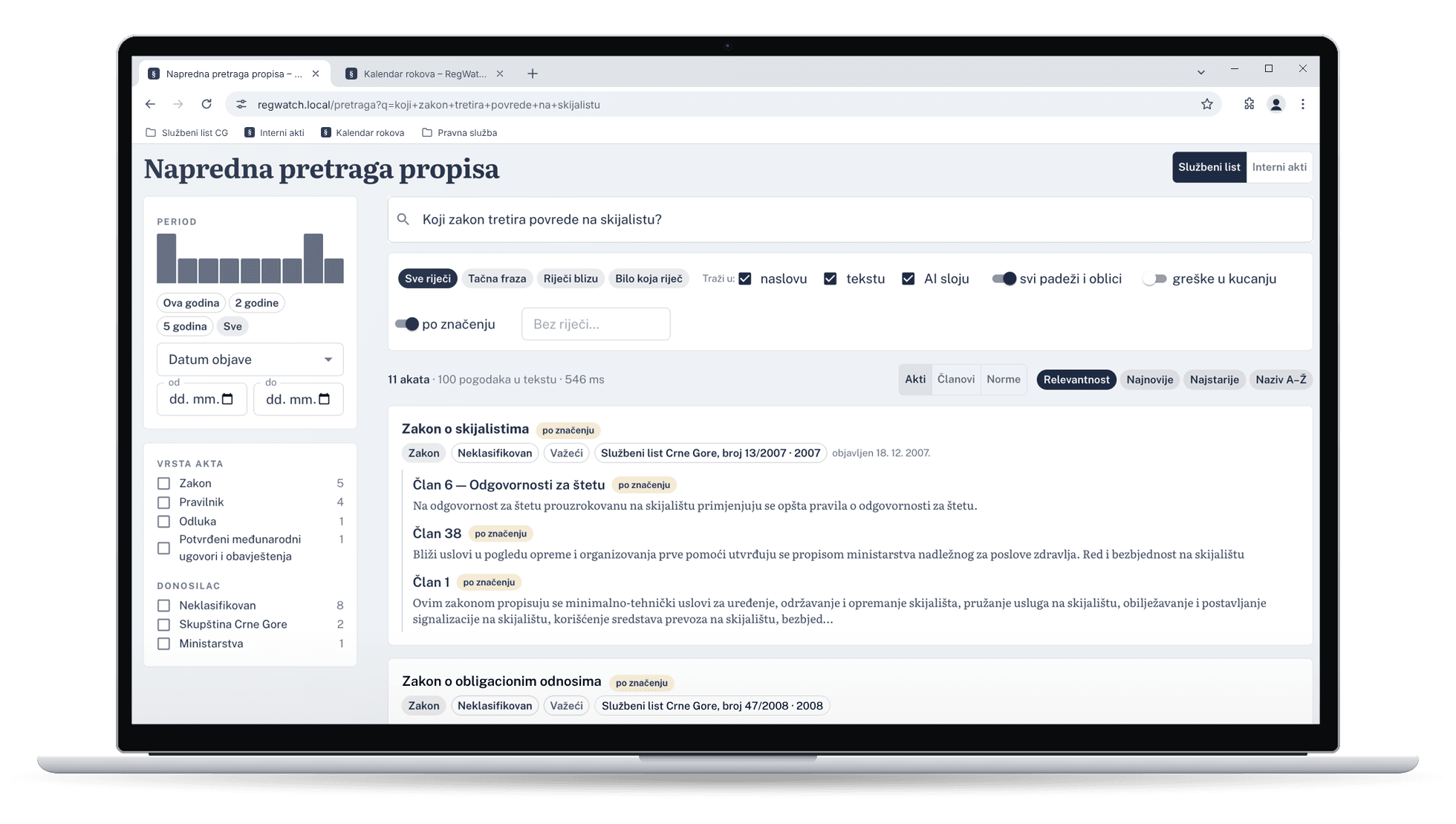
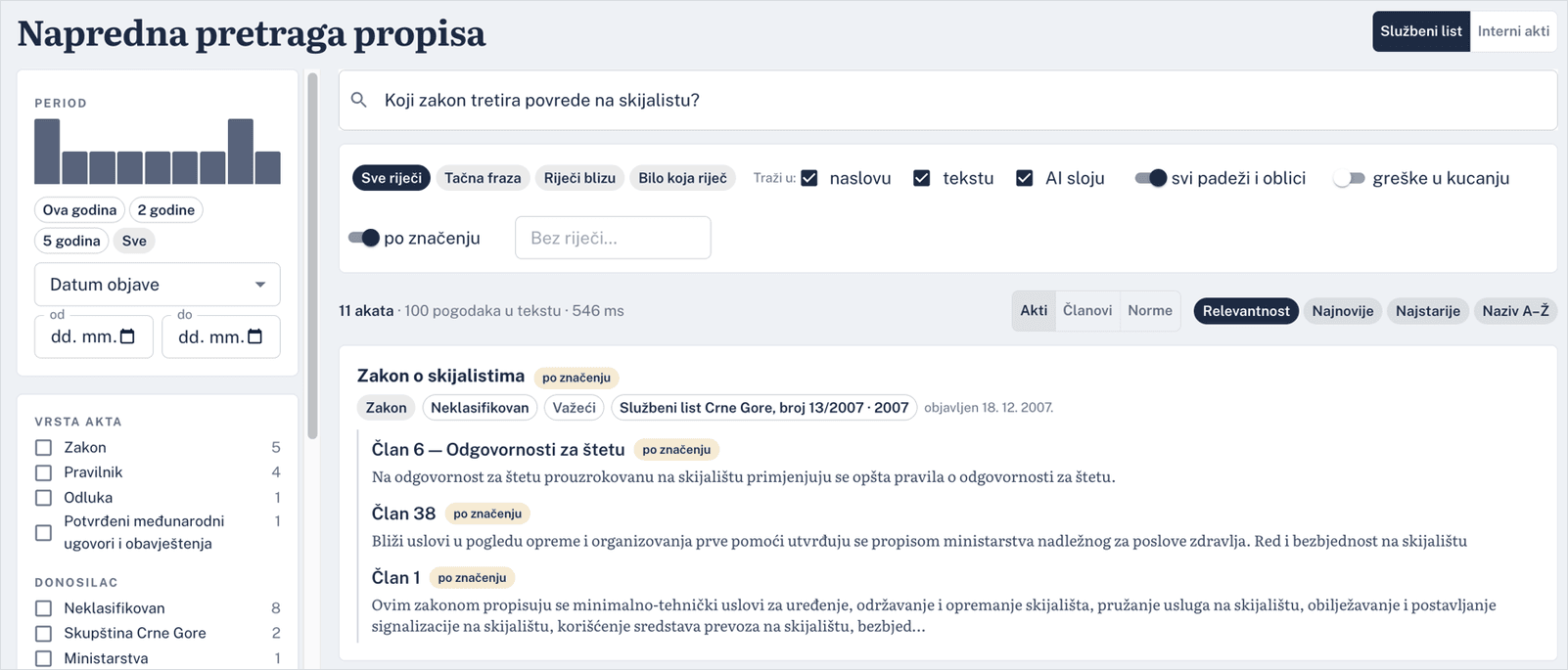
RegWatch searches 75,000 acts by keyword and by meaning, across all grammatical cases and word forms. Ask "Which law covers injuries at ski resorts?" and in half a second it returns the Law on Ski Resorts and the matching article. You don't need to know the name of the law - it's enough to know the question.
Internal acts: your documents, the same engine as for laws
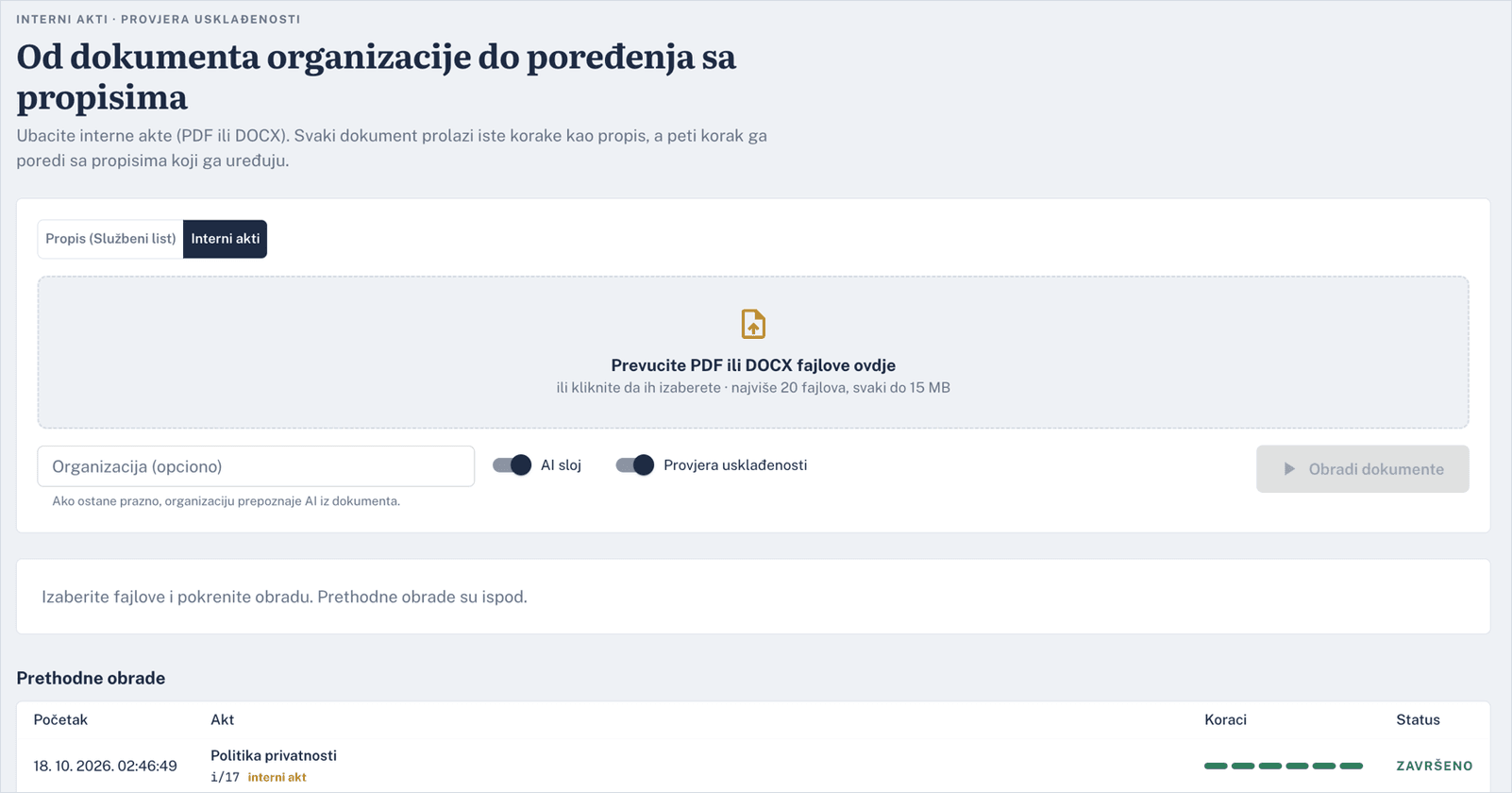
Upload insurance terms, rulebooks and policies as PDF or DOCX, up to 20 files at once. Each document goes through the same steps as a regulation (text, articles, AI layer), and a fifth step compares it with the regulations that govern it. Nothing needs to be prepared: the AI recognises the organisation and the relevant regulations on its own.
Compliance check: internal act and regulation, article by article
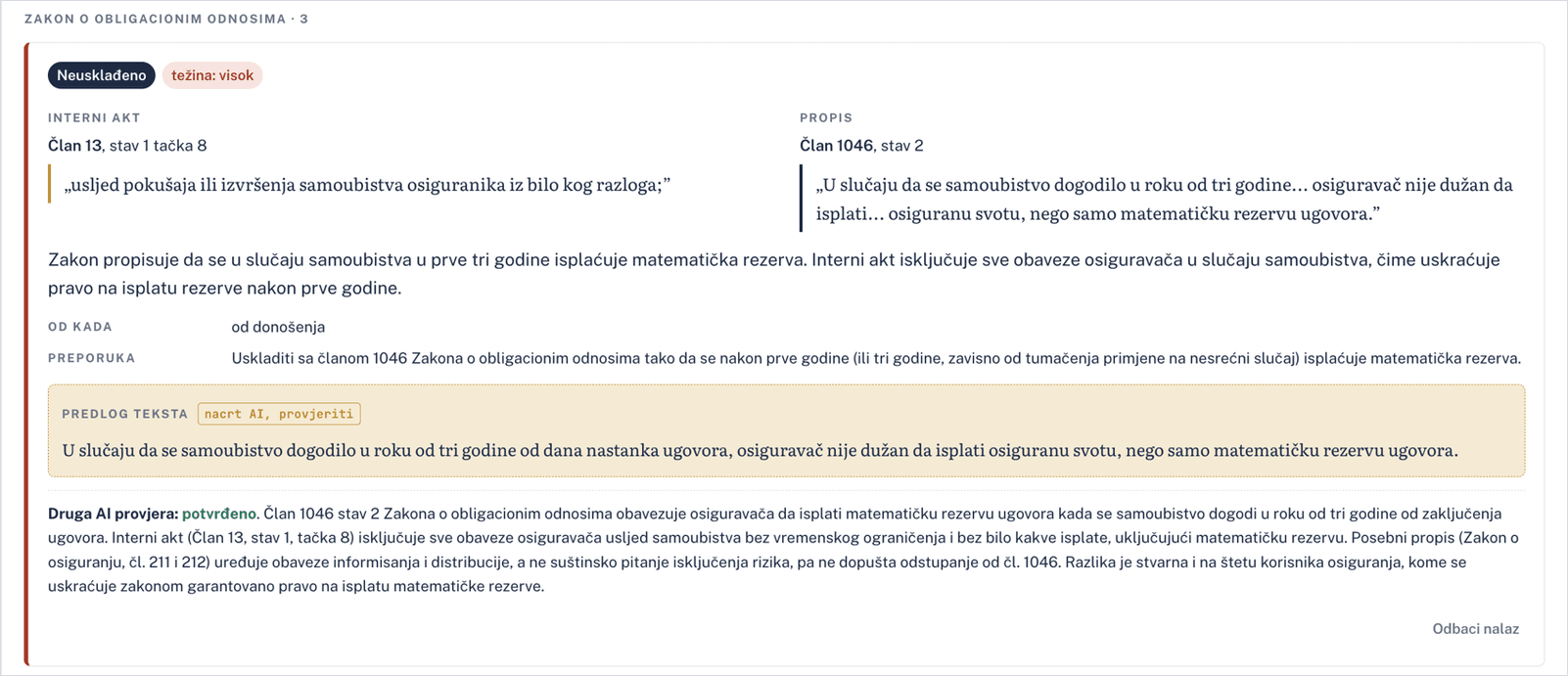
This is the heart of the product. For every article of an internal act, RegWatch finds the provision that governs it and shows the two side by side. Each non-compliance gets a severity, a recommendation and a suggested new wording.
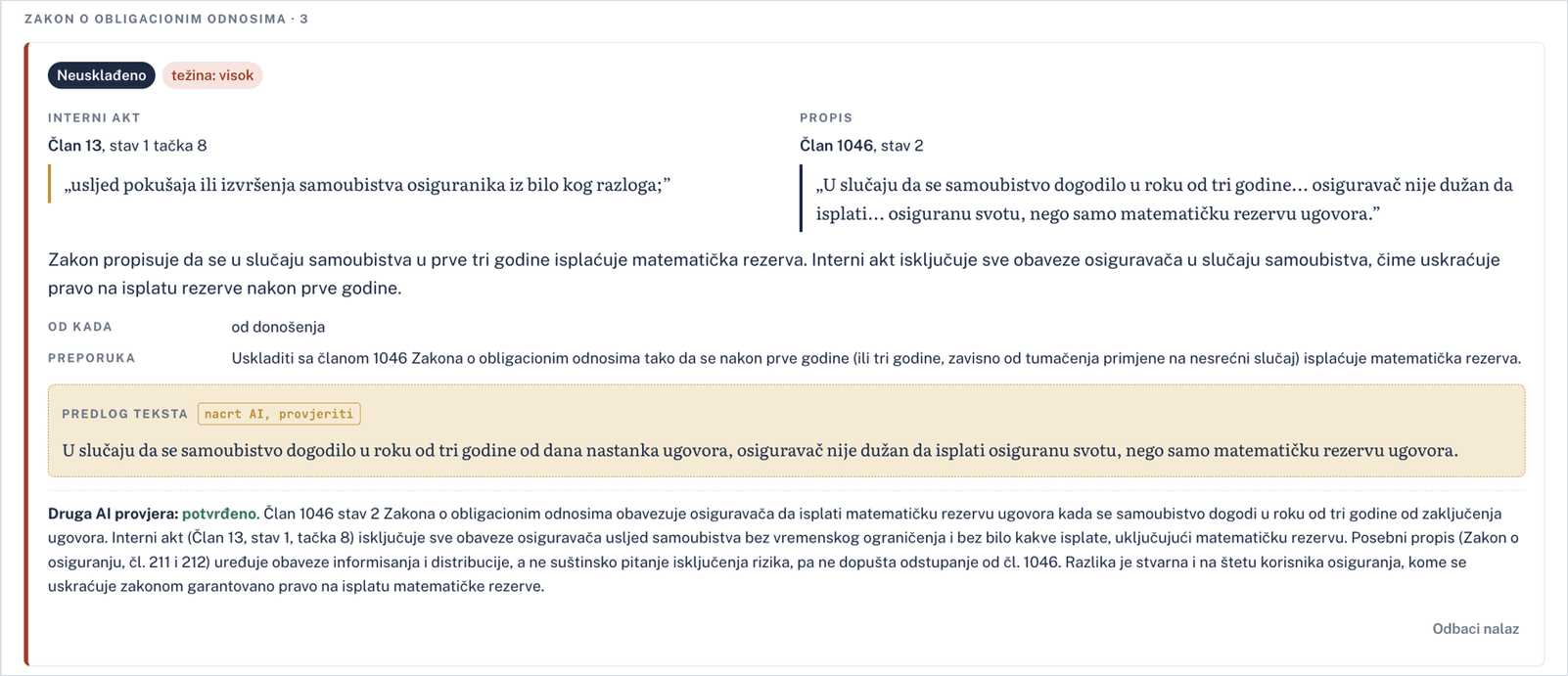
In one example, an insurer's terms excluded any obligation in the event of the insured person's suicide. Article 1046 of the Law on Obligations says otherwise: if it happens within the first three years, the insurer pays out the mathematical reserve of the contract. RegWatch flags the finding as non-compliant, high severity.
Before a finding reaches the lawyer, a second, independent AI check confirms it. The suggested wording is clearly labelled as an AI draft, and the lawyer accepts or rejects every finding.
Relationship graph: see what falls when a law changes
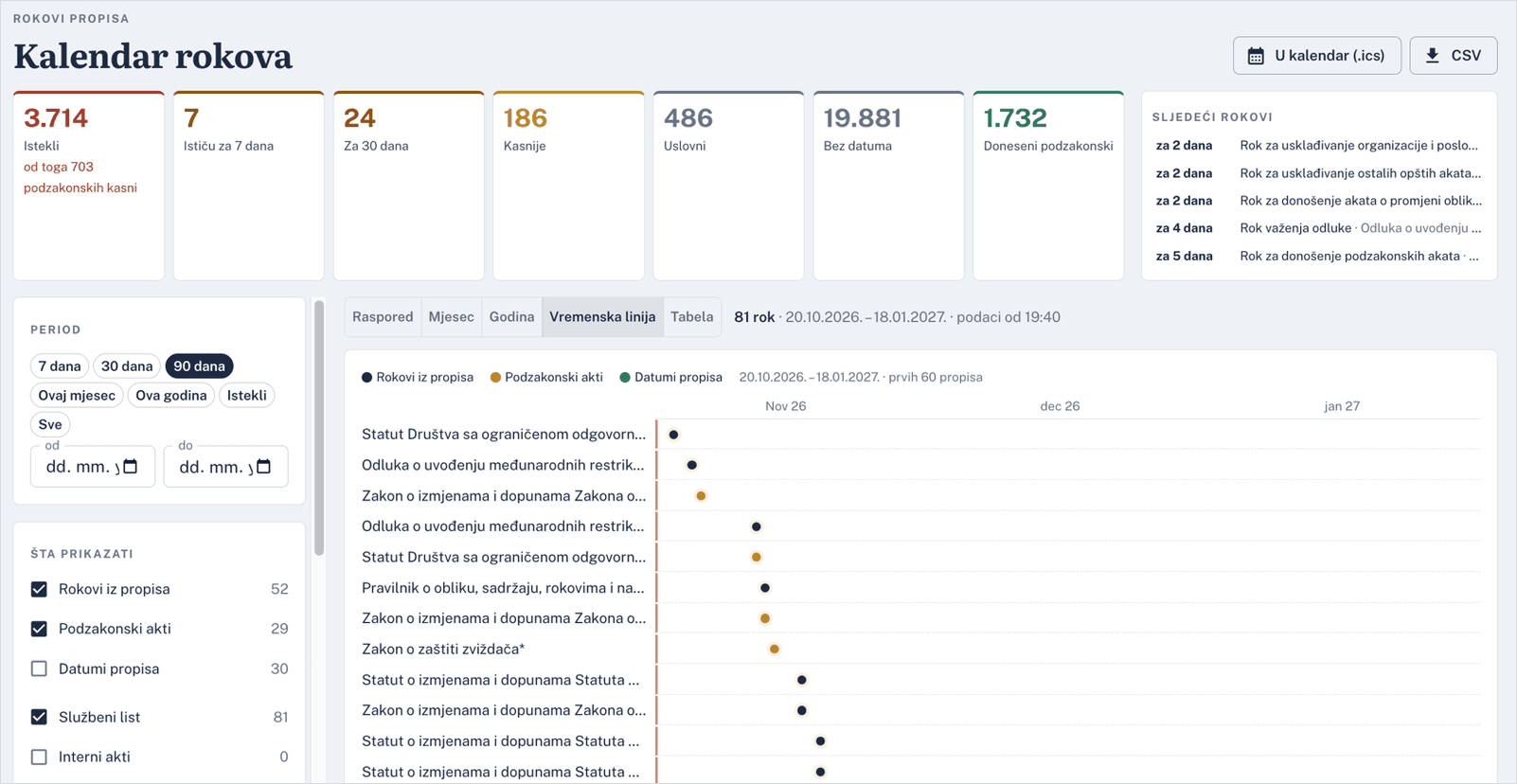
Every act is a node, and every link from the Official Gazette is an arrow: legal basis, amendment, repeal. In a single view you can see what depends on the law that is changing and which related acts are no longer in force.
Deadline calendar: no statutory deadline goes unnoticed
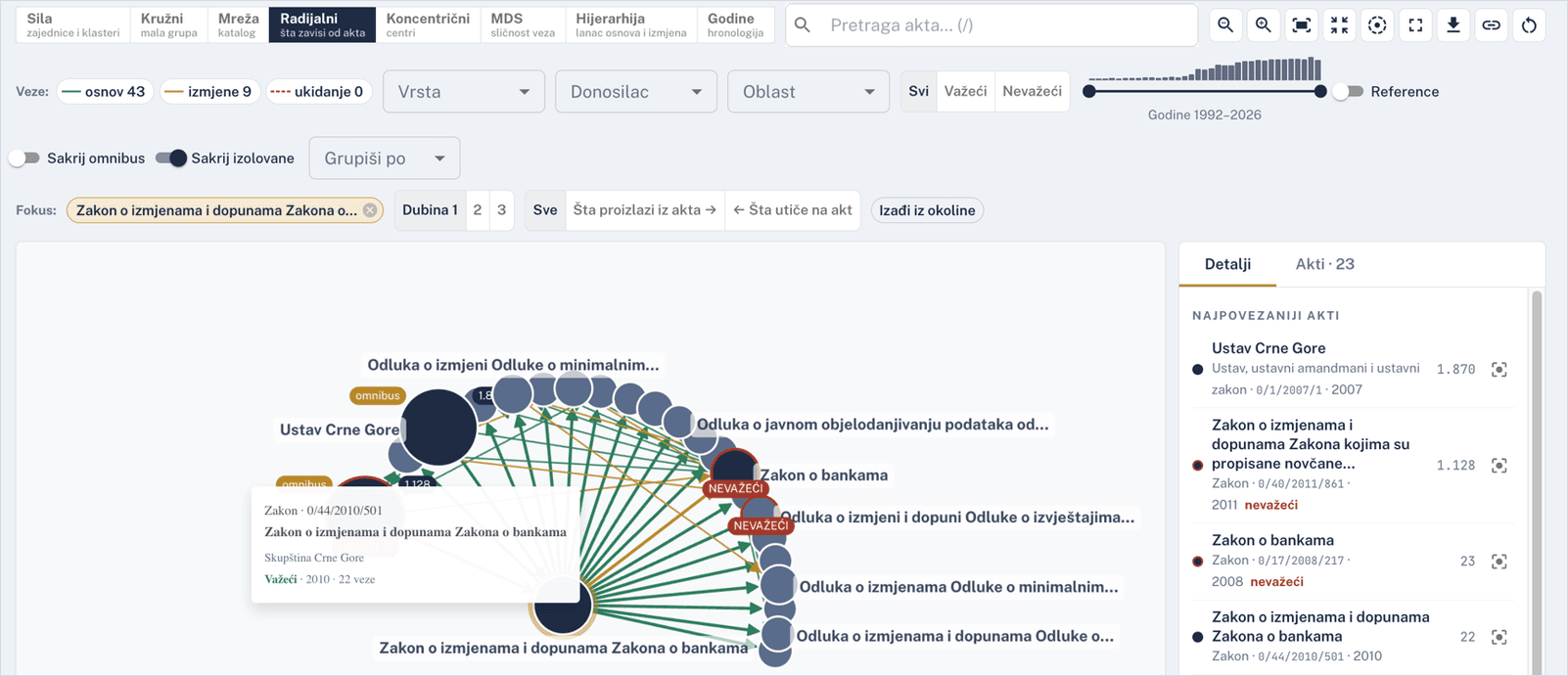
The AI extracts deadlines from the text of regulations: when something enters into force, by when the organisation has to comply, and which bylaw must be adopted. The legal team sees what expires in 7, 30 or 90 days and exports the deadlines to their own calendar.
Offline: your documents stay with you
Where do your documents end up? Exactly where they started. RegWatch runs AI in a local environment, with an offline model. It can work with large models too, but we put in the effort to make small, fine-tuned models deliver equally good results. That gives a major advantage: none of your documents leave your offices or get shared with anyone.
Built with Crnogochi
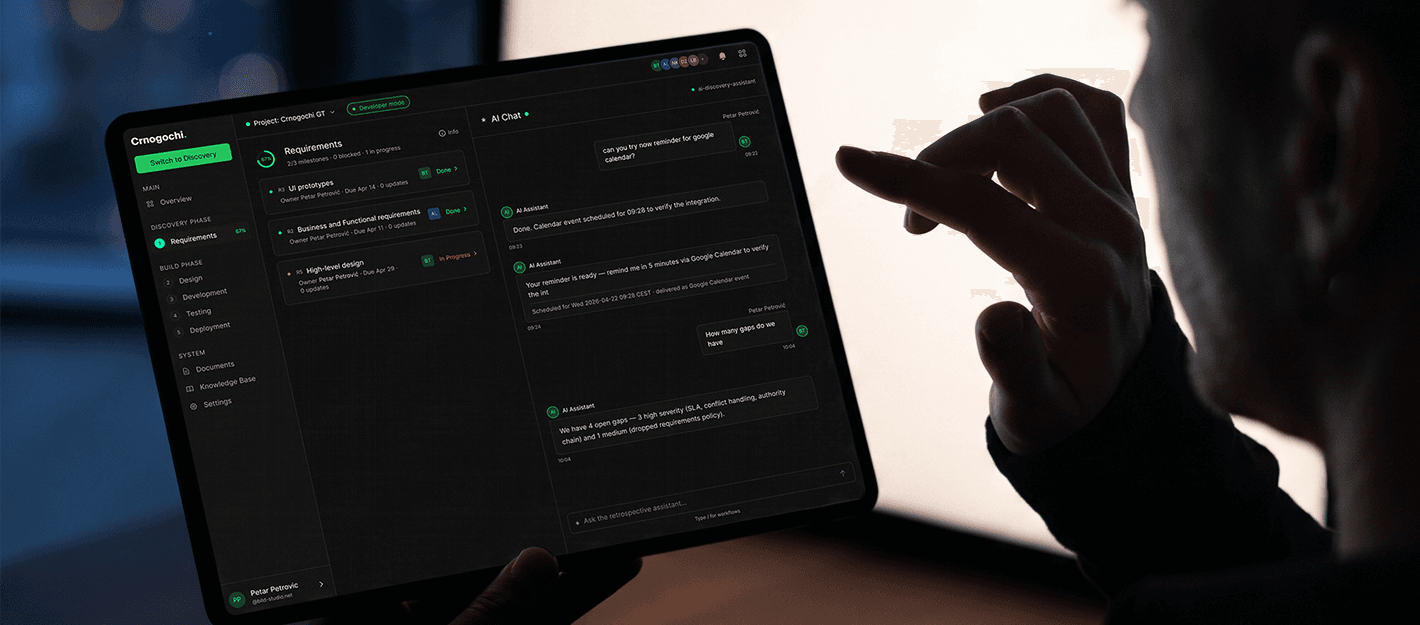
RegWatch was built with Crnogochi, our methodology for AI-enabled software development. Crnogochi covers the whole lifecycle: requirements, design, development, testing and deployment. A dedicated AI assistant serves each phase, and a shared knowledge base keeps them grounded in the project's own decisions and artefacts.
The rule is short: assistants propose, people decide. No merge, deploy or phase transition goes through without sign-off from a named person. Alongside the code come the requirements, documentation, user stories and tests - everything an engineer who inherits the product a year and a half from now will need.
If that sounds familiar, it's no coincidence. RegWatch works on the same principle it was built on: AI finds, compares and suggests - the lawyer decides.
"Fire and water are good servants but bad masters. So is AI."
Real data. Not a demo.
Numbers from the MVP's production database in October 2026 - real data, not a demo environment.
What the lawyer said

RegWatch is a valuable tool for the initial alignment of internal acts and regulations. The results significantly shorten manual alignment and speed up drafting a proposal for a new act. The findings still require review and verification by a lawyer, but the starting point the tool provides is a significant step forward for the whole process. The search is very efficient, as are the graphical views of laws and bylaws.
Where This Is Headed
The RegWatch MVP is being tested today by banks, insurance companies and law firms. They test it on real internal acts, because only there can you see whether the tool truly shortens the work.
What we like most in the review above is its third sentence. RegWatch doesn't give a final legal opinion - it gives a starting point that a lawyer checks and confirms. That's exactly how it was designed.
The next step is a pilot on your internal acts. And if that's not you, but you know someone who spends their days comparing laws and rulebooks, forward them this story. They'll thank you.


Want AI on your internal acts - without your documents leaving the building?
If you're a legal entity subject to internal process audits, aligning legal documents and implementation guidelines, and you want to use AI without compromising data confidentiality, get in touch to book a pilot on your internal acts.